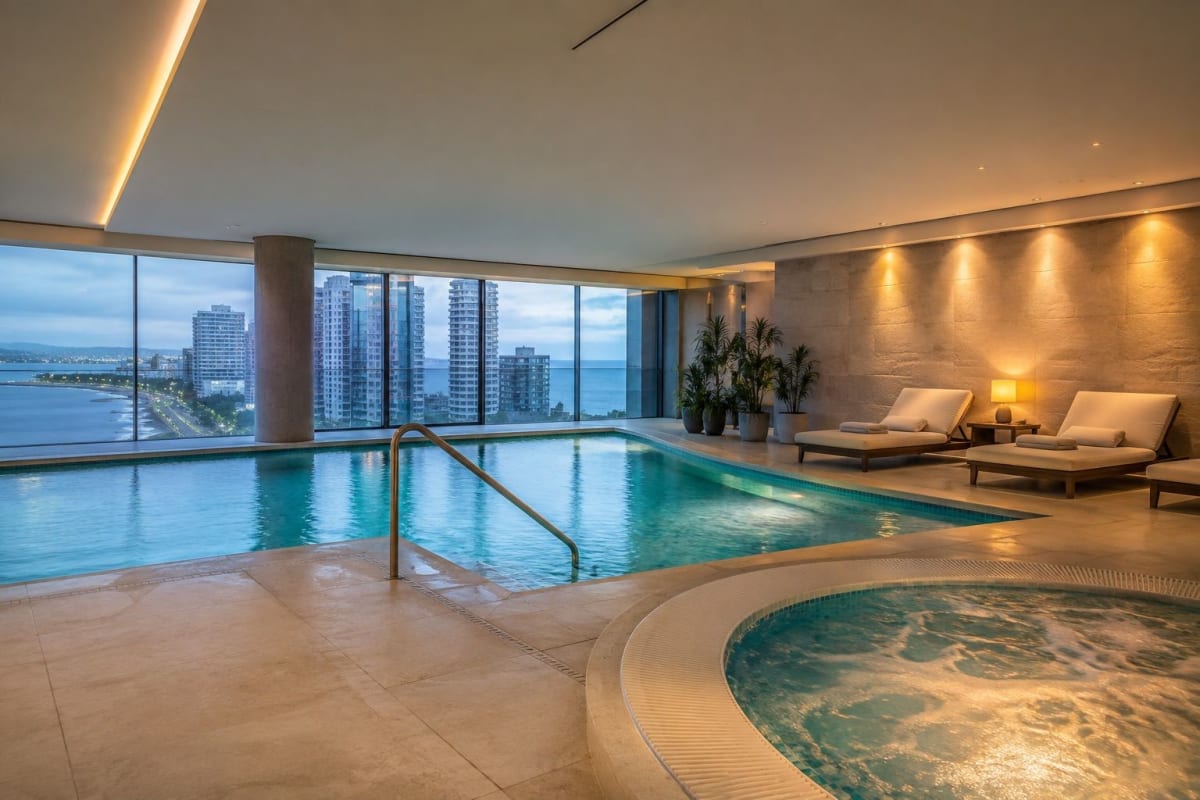
How to Buy a House in Uruguay and Avoid Costly Mistakes
Learn how to buy a house in Uruguay, what costs to expect, what to check, and how to avoid costly mistakes as a foreign buyer.
Punta del Este, Uruguay

Compare Punta del Este vs Piriápolis and discover where it makes more sense to live, buy property or invest in Uruguay real estate. This guide looks at cost of living in Uruguay, property prices, school fees, long-term rentals, Airbnb income, groceries and lifestyle differences along the Uruguayan coast.
By Liza – Founder & Real Estate Advisor at Punta HousesApril 24, 202615 min readWhen people compare our current selection of properties for sale in Punta del Este with our properties for sale in Piriápolis, they often start with one simple question: where is real estate cheaper? But that is actually the least interesting question. A better one is: which place fits the way I will actually live here?
A couple looking for a lock-and-leave apartment will calculate things very differently from a family with two children planning to live in Uruguay full-time. And that is exactly why Punta del Este and Piriápolis start to move in very different directions: not only in purchase price, but also in school costs, rental potential, daily expenses, and the amount of peace or convenience you are buying every month.
At first glance, these two coastal towns seem like neighbours. In real life, they are two different living models. Punta del Este offers international appeal, more services, stronger brand value, and greater tourism power. Piriápolis offers peace, a lower entry point, and often a more practical lifestyle for people who calculate over twelve months of the year, not only January and February.
This is where the comparison becomes interesting. Many buyers expect Piriápolis to be much cheaper than Punta del Este at every level, but for smaller apartments that is not always true.
In Punta del Este, a 1-bedroom apartment costs around USD 169,045 on average, typically with a surface area between 37 and 56 m². In Piriápolis, a 1-bedroom apartment is surprisingly close to that figure, at around USD 169,000, usually between 37 and 65 m².
In other words, for a couple or single buyer looking for a compact coastal apartment, the price difference may be smaller than expected. This is especially relevant for buyers looking for a second home in Uruguay, a small rental unit, or an easy-to-maintain apartment near the beach.
But once you move toward an apartment where a family could realistically live, the story changes. In Punta del Este, a 2-bedroom apartment is around USD 270,000 for 69 m², while in Piriápolis, a 2-bedroom apartment is closer to USD 180,000 for 63 m². With 3-bedroom apartments, the difference becomes even clearer: around USD 417,000 in Punta del Este compared with approximately USD 340,000 in Piriápolis.
That is the moment when many buyers realise that Punta del Este real estate becomes significantly more expensive once you need more than a beautiful pied-à-terre near the sea.
The difference becomes much clearer when you compare houses. A 3-bedroom house in Punta del Este averages around USD 420,000, often with approximately 185 m² of built area and larger plots. In Piriápolis, a 3-bedroom house averages around USD 230,000, with a typical built area of about 126 m².
That is not just a small difference. It is an entirely different life stage expressed in numbers. The price gap between these two markets could cover years of school fees, renovations, or a strong financial buffer.
This is what makes houses in Piriápolis so attractive for long-term residents. Punta del Este often makes sense for buyers looking for prestige, prime location, and international recognition. Piriápolis often makes sense for buyers who want space without every decision being priced as a premium lifestyle choice.
This matters especially for families or buyers planning a full-time move to Uruguay. You are not only buying a house. You are also buying the freedom not to feel, every single month, that you live in the more expensive market.
Let’s take a very recognisable example: a family with two children that wants to live permanently on the coast and values private education.
As a working estimate, private school in Punta del Este can cost around USD 800 per child per month. For two children, that means USD 1,600 per month for school alone. Add private healthcare through a mutualista at around USD 80 per person per month for four people, and you add another USD 320 per month.
Before housing, car costs, groceries, and leisure even enter the picture, this family is already looking at approximately USD 1,920 per month in fixed family costs.
Now add a house around USD 420,000, or a 2-bedroom apartment around USD 270,000, and it becomes clear why Punta del Este can be wonderful, but not “accidentally affordable.” For families who consciously want that international, comfortable rhythm, it can make perfect sense. For others, it may start to feel heavy.
Public education in Uruguay remains broadly accessible and free, which can completely change the calculation for some families. But for buyers planning around private schooling, education becomes one of the biggest cost differences between living in Punta del Este and living in Piriápolis.
What Punta del Este offers in return is convenience. Residents are closer to a wider range of services, a broader international community, stronger high-end rental and resale stories, and a market that is often easier for foreign buyers to understand.
But that advantage only has real value if it matches your daily life. Otherwise, you may end up paying for options you only half use. And that is where some buyers later feel regret: not about the property itself, but about the monthly rhythm that comes with it.
Now place that same family in Piriápolis, using the same working figures. Private education no longer costs USD 1,600 per month, but around USD 500 per month for two children. Healthcare remains roughly USD 320 per month for a family of four.
So before housing costs, the family is at approximately USD 820 per month instead of USD 1,920. That is a difference of USD 1,100 per month, or USD 13,200 per year. Over five school years, that becomes USD 66,000 — before anyone has even walked into a supermarket.
For many families, this is the real eye-opener. The difference between Punta del Este and Piriápolis does not only live in the asking price. It lives in the monthly reality.
Public schooling is also free in Piriápolis, just as it is in Punta del Este, so for families open to the public system, the comparison may change again. But for families choosing private education, the difference is enormous.
Piriápolis also often allows families to live with more space and less financial friction. A 3-bedroom house around USD 230,000 does not only feel more accessible at the moment of purchase. It can also feel psychologically lighter over the long term.
So the difference is not that Piriápolis is “cheap.” The difference is that in Piriápolis, living, raising children, and managing a household often feel more aligned. And for people looking not just for a holiday home, but for a real home, that is a fundamental difference.
Investors eventually ask the same question: what can this property generate?
In Punta del Este, long-term rental income varies widely. A compact 1-bedroom apartment in the Península may be offered for sale around USD 105,000, with a listed annual rental price of UYU 32,000 per month. Using a reference exchange rate of UYU 39.757 per USD, that equals roughly USD 805 per month, or just above 9% gross yield on that specific entry-level unit.
That sounds strong, but it is also a small, older apartment of about 33 m². A more typical 1-bedroom apartment in Punta del Este averages around USD 169,045, while annual rental examples today often start around USD 800 or UYU 35,000 per month. In that case, the gross yield is more likely to fall around 5.5% to 6.5%, before common expenses, maintenance, vacancy, and management.
With 2-bedroom apartments in Punta del Este, everything depends even more on the building and location. Current annual rental examples include USD 900 for a smaller Península unit, USD 1,400 in Aidy Grill, and even a median annual rental around USD 2,200 for furnished 2-bedroom apartments in Aidy Grill.
Compare that with a median purchase price of around USD 270,000 for a 2-bedroom apartment in Punta del Este, and you immediately see why two properties in the same city can be completely different investments. In one case, the gross yield may be around 4% to 6%. In another, it may be much higher — but usually with more expensive buildings, higher monthly costs, or a very specific rental profile.
In Punta del Este, the city itself is not enough. The product matters.
In Piriápolis, long-term rental income is usually less spectacular, but often easier to understand. A basic 1-bedroom apartment in the centre may rent for around UYU 22,000 per month, while newer or better units near the rambla or in projects such as Amarras Reales or Sea Side may range between UYU 30,000 and UYU 36,000 per month.
A 2-bedroom apartment in the centre may appear around UYU 26,000, while 3-bedroom houses often rent for approximately UYU 30,000 to UYU 38,000 per month.
Set that against a 1-bedroom purchase price of around USD 169,000, or a 3-bedroom house around USD 230,000, and many properties land around a gross annual rental yield of roughly 4% to 6%.
That may sound less exciting than some Punta del Este stories, but it also usually comes with less capital tied up and fewer surprises.
For short-term rentals, Punta del Este remains the larger machine. According to 2026 market data mentioned in the source text, Punta del Este has around 2,915 active listings, an occupancy rate of 31.7%, an ADR of USD 184, and an average annual revenue of USD 11,052 per listing. Another data point for the same market refers to USD 14,320 in annual revenue, 32.8% occupancy, and a USD 185 ADR. Airbtics is more optimistic, reporting approximately 3,131 listings, 45% occupancy, a USD 138 ADR, and around USD 22,946 in annual revenue.
That wide spread between data providers is a lesson in itself: Airbnb can work well in Punta del Este, but the gap between an average listing and a well-positioned listing is large.
Piriápolis also has a short-term rental market, but with a very different profile. AirROI places Piriápolis at around 403 active listings, 29.6% occupancy, USD 108 ADR, and USD 5,862 in annual revenue per listing.
In other words, tourism income exists, but there is less scale and less room for mistakes. A property in Piriápolis is rarely purchased because Airbnb alone carries the entire investment case. It is more often a good living property that can also perform well during the season.
In Punta del Este, you can still aim for real tourism upside. In Piriápolis, the smarter strategy is usually to focus on entry price, location, and realistic expectations.
Many people assume that Piriápolis will feel much cheaper every week at the supermarket. In reality, the difference is smaller than expected.
The official SIPC analysis by Uruguay’s consumer defence unit shows that the eastern coast is more expensive than Montevideo, but the difference between the two beach towns is uneven. In the first half of January 2026, Punta del Este was on average 5.0% above Montevideo, while Piriápolis was only 1.1% above Montevideo.
So yes, Punta del Este is structurally the more expensive supermarket location of the two. But not to the extent that groceries alone should decide your life.
Looking at indicative product prices, the same conclusion appears. Numbeo places 1 litre of milk at around UYU 48.75in Punta del Este and UYU 40.79 in Piriápolis; 500 grams of bread at UYU 114.80 versus UYU 96.38; 1 kilo of rice at UYU 69.76 versus UYU 64.51; and 1 kilo of chicken breast almost identical at UYU 446.16 in both places. Apples are even slightly higher in Piriápolis.
The message is simple: yes, Punta del Este is often more expensive, but you do not win or lose your budget on milk, bread, or chicken. The major differences are in property type, school choice, and how premium your daily life becomes.
With restaurants, the picture is even less straightforward. Numbeo places a simple restaurant meal at around UYU 600 in Punta del Este and UYU 700 in Piriápolis, while a dinner for two in a mid-range restaurant is around UYU 2,100 in Punta del Este and UYU 2,343 in Piriápolis.
That sounds counterintuitive, and that is exactly why restaurants are not the best decision-making category. Prices depend heavily on the restaurant, view, season, and type of experience. In practice, people in Punta del Este often spend more because there is more choice, more social activity, and more temptation to “just go out for something.”
So the difference is not only on the menu. It is also in behaviour.
The honest conclusion is that Punta del Este is not simply “too expensive,” and Piriápolis is not just “the cheaper version” of the same thing. They are two different answers to two different questions.
Choose Punta del Este if you want international appeal, stronger tourism upside, a market that is more recognisable to foreign buyers and renters, and you are willing to pay a premium for that position.
Yes, Punta del Este is generally more expensive than Piriápolis, especially when it comes to larger apartments, family homes, private school fees, and lifestyle spending. However, the difference is smaller for compact 1-bedroom apartments, where entry-level prices can be surprisingly similar. The real cost gap becomes clearer when you compare full-year living expenses, not just property prices.
Yes, Piriápolis can be a very practical choice for full-time living in Uruguay, especially for families, retirees, and remote workers who want a quieter coastal lifestyle with lower monthly costs. It usually offers more space for your money, more manageable school costs, and a calmer rhythm than Punta del Este, while still being close enough to Maldonado and Punta del Este for services and day trips.
Punta del Este usually offers stronger tourism appeal, higher short-term rental potential, and more international recognition, which can make it attractive for investors. Piriápolis often offers a lower purchase price and a more stable long-term living profile. In simple terms: Punta del Este is often stronger for Airbnb and premium positioning, while Piriápolis can be smarter for affordability, long-term rentals, and lower entry costs.
Yes, foreigners can buy property in both Punta del Este and Piriápolis under the same conditions as locals. Uruguay has a relatively open property market for foreign buyers, making both locations attractive for people looking for a second home, retirement property, rental investment, or permanent move to the Uruguayan coast.

Liza is the founder of Punta Houses, with a background in real estate, construction, and tourism. After traveling across all continents and living as an expat in South America for over 12 years, she has developed a strong understanding of what international buyers are truly looking for. It is rarely just about a property — it is about lifestyle, location, and the right feeling. With a refined perspective on real estate and in-depth knowledge of the local market, Liza guides clients through every step of the buying process. Her approach is discreet, personal, and focused on finding the right match, with attention to detail and long-term value. She works with clients from around the world and communicates fluently in Dutch, English, Spanish, French, and German, ensuring a smooth and professional experience on an international level. For Liza, real estate is about more than transactions. It is about trust, insight, and creating opportunities that truly align with each client’s lifestyle and ambitions.

Learn how to buy a house in Uruguay, what costs to expect, what to check, and how to avoid costly mistakes as a foreign buyer.

Buy property in Uruguay as a foreigner in 2026 with more confidence. Learn about ITP, legal steps, the escribano, and how to navigate Uruguay real estate safely in Punta del Este and beyond.