
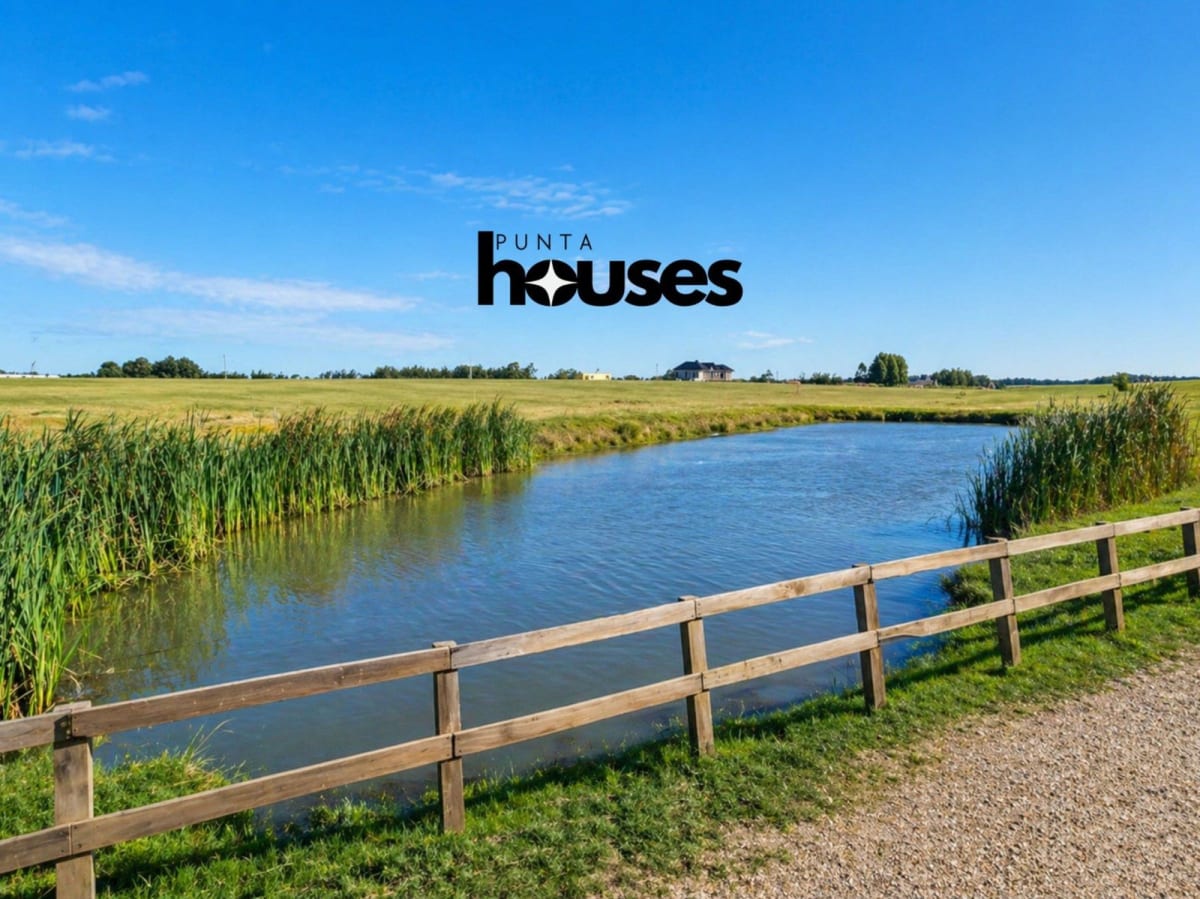


1 Hectare in Narbona La Plantación | La Barra
$ 390,000
Description
There is a particular idea behind Narbona La Plantación that sets it apart from every other private development on the Ruta 104 corridor: the land is not just yours to build on — it is part of something that is already producing. Fruit trees, lavender, vineyards, organic kitchen gardens, farm animals for fresh eggs and dairy. Six artisan production workshops on the communal grounds. A Greenmarket where what the community grows is sold. And a commercial agreement with Narbona — the storied winery and restaurant brand behind the project — to transform the fruit harvest into jams and preserves sold under the Narbona name in shops along Route 104. The production income flows back to reduce community expenses. The landscape is managed by a renowned Uruguayan landscape architect. This is not a subdivision that calls itself an agricultural community. It is one.
The development comprises around 50 chacras of approximately one hectare each, laid out along the Ruta 104 corridor at kilometre 5.5 — 5.5 kilometres from the coast at Manantiales, adjacent to Pueblo Mío, and with a secondary entrance through the Narbona Restaurant via the Golf Road. The architecture is regulated: pitched roofs only, no flat structures, a deliberate coherence of style that gives the neighbourhood the visual character of a Uruguayan farming hamlet rather than a scatter of individually styled weekend houses. Security runs 24 hours. The property tax classification is rural, which carries a meaningful fiscal advantage over urban real estate.
The Neighbourhood Context
The plot sits between two of the most significant landmarks on the Ruta 104 corridor. To one side, Pueblo Mío — one of the most sought-after luxury gated communities in the Manantiales area, where completed houses change hands at $1.5 million and above — establishes the residential standard. To the other, the Fundación Pablo Atchugarry and its MACA museum — a 90-acre sculpture park and contemporary art museum designed by Carlos Ott, opened in 2022, and already receiving visitors from across Europe and the Americas — establishes something rarer: a world-class cultural institution as a literal neighbour. The view from several plots in the development takes in the foundation's eucalyptus landscape and water features.
The Narbona Restaurant itself, accessible via the Golf Road entrance to the development, has been a reference point for farm-to-table dining in this part of Uruguay for years — the kind of institution that anchors a food culture rather than simply participating in it. The Garzón School, a bilingual institution with an internationally credentialled teaching staff drawing from as far as Australia and the UK, serves the families who have made this corridor their permanent base. The beach at Manantiales is 5.5 kilometres away — ten minutes by car, a different world in character.
What a Plot Here Offers
One hectare at Narbona La Plantación is enough land to build a properly generous house with garden, pool, and outdoor living spaces while still having room — if the inclination exists — for a small productive plot of your own: a few rows of vine, an olive tree or two, a kitchen garden that the communal agricultural framework can help manage when you are not there.
The cooperative model is the key differentiator. Most agricultural lifestyle developments require the owner to manage production independently, which in practice means either hiring staff or watching the land revert to grass. La Plantación's model — shared infrastructure, communal production, Narbona as the commercial off-take partner — means the land stays alive and productive whether or not you are present. For a European buyer accustomed to the economics of small-scale wine or olive production in France, Italy, or Portugal, the comparison is straightforward: lower land cost, no appellation bureaucracy, a ready market in one of South America's most affluent coastal corridors, and a production partner with an established brand and distribution network already in place.
The rural tax classification is not a footnote. In Uruguay, rural property is taxed at a significantly lower rate than urban real estate, and the classification is maintained regardless of the residential use of the plot — a meaningful annual saving for owners who are not generating agricultural income year-round.
Building Here
Construction regulation at La Plantación requires pitched roofs and prohibits flat roof architecture — a rule that may seem restrictive until you see the result: a neighbourhood with a visual coherence that the unregulated developments along the corridor entirely lack. Within those parameters, the range of what has been built is broad: compact two-bedroom retreats, full four-suite family homes with covered social terraces and double-height living rooms with exposed timber beams, and everything between. Infrastructure is complete — roadways, water, electricity — which means a build can begin without the preliminary works that add cost and time to rawer plots on this corridor.
For a buyer who wants to build to their own brief in one of the most culturally and gastronomically rich rural locations in South America, within reach of the beach, with a working agricultural community already around them and a museum at the end of the road — this is the plot.
The listed price does not include the real estate commission (3% + VAT), notary fees, or ITP.
Specifications
Location
Contact Agent
Explore the Manantiales neighbourhood guide.