Manantiales
Living in Manantiales, Punta del Este
There is a moment every summer when Manantiales becomes the most talked-about place on the Uruguayan coast. It is not a moment that arrives politely — it arrives with the season, with the Argentines and Brazilians and Europeans who have been coming to this stretch of Atlantic shore for decades and who know that the eastern beaches, the paradores, the art galleries, and the restaurants along Ruta 104 offer something that the Peninsula and even La Barra cannot quite replicate. That combination — beach energy at a world-class level, cultural infrastructure that most coastal resorts would envy, and an inland corridor that is quietly becoming one of the most interesting lifestyle and investment zones in South America — is what makes Manantiales, in 2026, the most dynamic neighbourhood in Punta del Este.
The town sits at kilometre 165.5 on Route 10, roughly equidistant between Punta del Este and José Ignacio. Its name comes from the natural spring (manantial) located at its eastern end, a geographic detail that was once a practical landmark and is now the kind of etymological footnote that pleases residents who have done their research. The town covers approximately 40 blocks facing the Atlantic and extends inland along the Ruta 104 corridor into a zone of lifestyle farms, cultural institutions, and private communities that has developed its own distinct character — equally important to understanding Manantiales as the beach strip that most visitors see first.
Bikini Beach & the Atlantic Coast
The social geography of Manantiales is anchored by Bikini Beach — a stretch of Atlantic-facing shore that evolved from a local surfing spot into the most internationally recognised beach scene on the Uruguayan coast. The water here is genuinely powerful: deep, with natural rocky protection that creates small bays and consistent surf conditions, and waves that can reach two metres on the right swell. Surf schools have operated here for years — the most storied of them a wooden shack marked with a painted yellow sun that has introduced generations of visitors to the Atlantic breaks. Jet skiing, stand-up paddleboarding, and bodyboarding all have their communities and their regular practitioners on this stretch.
But Bikini Beach in January is also a social institution in a way that few beaches anywhere in the world can claim. The paradores — beach clubs that range from simple to architecturally ambitious — host fashion shows, DJ sets, and VIP events that draw crowds from Buenos Aires, São Paulo, and increasingly from New York and London. Lifeguards patrol from mid-December to mid-March. The afternoon crowd is characteristically diverse: surfers and families, the well-heeled and the merely young, the permanent residents who come every day and the summer visitors for whom Bikini Beach was the primary reason to make the trip. At sunset, the bars extend the beach's social momentum well into the evening.
Playa Montoya, immediately adjacent, offers a more relaxed alternative — popular with families and with a slightly younger demographic that values the surf without the high-season performance. Playa El Tesoro, further east, is quieter still. Manantiales' stretch of coast has enough variation to accommodate different temperaments simultaneously, which is precisely what has made it the address of choice for such a broad international cohort of buyers and renters.
MACA: A World-Class Museum as a Neighbour
The most significant cultural development in the history of the Ruta 104 corridor arrived in January 2022, when the Museo de Arte Contemporáneo Atchugarry — MACA — opened on its 90-acre estate at kilometre 4.5 of Ruta 104. Designed by Uruguayan architect Carlos Ott (who also designed the Atlántico Shopping complex in Punta del Este), the building is itself a work of significant architectural ambition: an ark-shaped structure of over 5,000 square metres clad in glass and aluminium with a curved roof of Red Grandis eucalyptus timber that appears almost to be in motion on its landscaped terrain.
The foundation behind MACA was established in 2007 by Pablo Atchugarry — the Uruguayan marble sculptor who divides his time between his studio in Lecco, Italy, and his estate in Manantiales — to promote Uruguayan art and culture. The sculpture park that surrounds the museum building covers 90 acres of lawns, water features, and gently rolling hills, with large-scale works by Uruguayan and international artists placed throughout in a landscape that Atchugarry curates himself. The December-to-January programme is consistently strong: the 2025–2026 season featured the first exhibition in Uruguay dedicated to Lucio Fontana, alongside a major retrospective of concrete and informalist Uruguayan art from 1947 to 1970. Free admission makes it accessible to the full spectrum of Manantiales' community, from the art world visitors who fly in specifically for the openings to the families who walk the sculpture park on weekend mornings.
The impact of MACA on property values in the surrounding area has been documented and substantial. Multiple market analysts have noted a significant spike in demand for properties along the Ruta 104 corridor following its 2022 opening — a pattern consistent with the broader principle that cultural infrastructure of genuine quality anchors real estate appreciation in ways that pure lifestyle amenities rarely do.
Ruta 104: The Inland Corridor
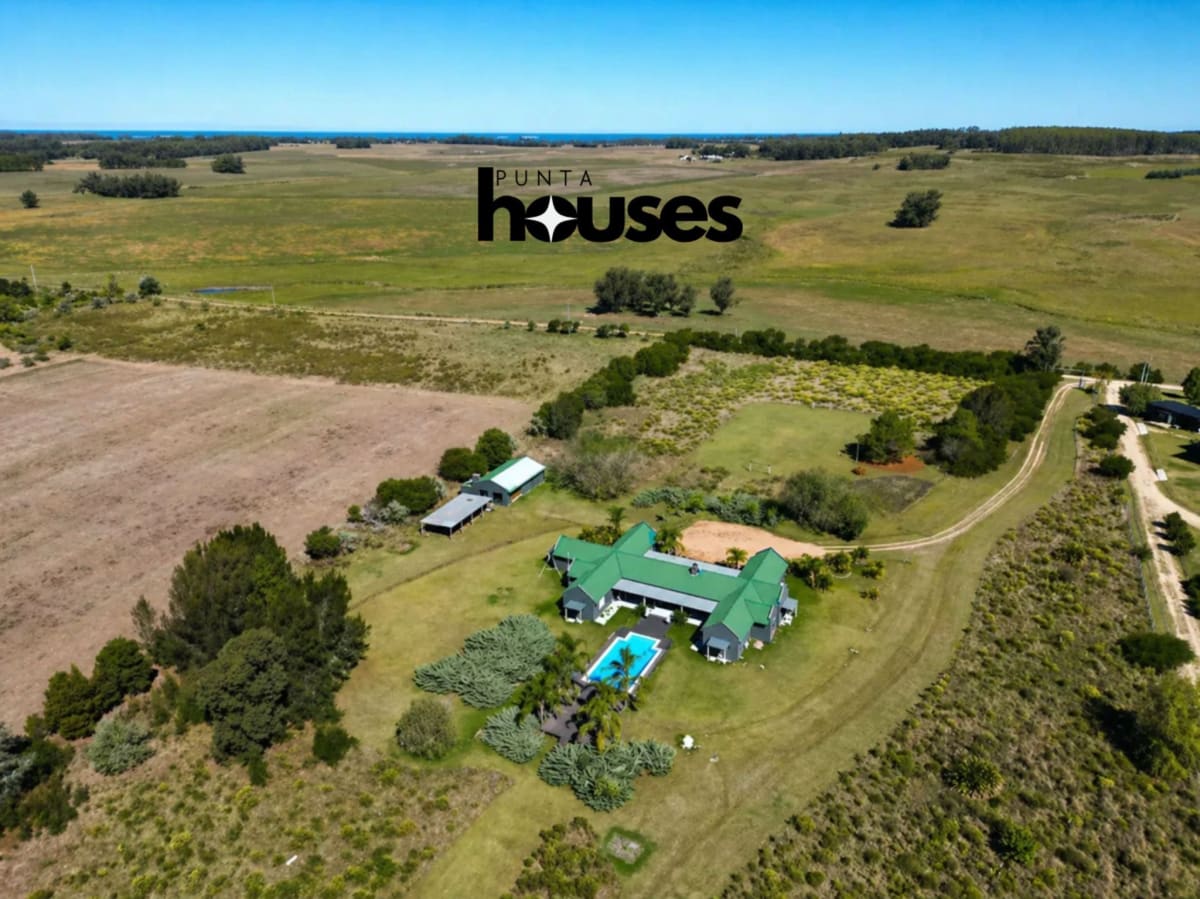
The road that runs inland from the coast behind Manantiales — Ruta 104 — has become one of the most interesting lifestyle corridors in Uruguay. Along its approximately 15-kilometre length from the coast toward Route 9, it passes through a landscape of organic farms, boutique wineries, private chacra communities, cultural institutions, and gated estates that together constitute a rural-coastal hybrid zone found nowhere else on the Uruguayan coast.
Narbona's restaurant and production operation at kilometre 5 — the Punta del Este extension of the storied Carmelo winery brand, operated by the Cantón family — anchors the corridor's gastronomic identity. Artisan production of dairy, cured meats, pastas, spirits, bread, and cheese happens in the workshop buildings; the restaurant serves under a wisteria terrace by day and by candlelight in the garden by evening. Galería del Paseo, at the coast end of the corridor, has built an international reputation for its seasonal exhibitions of Latin American contemporary art. The Garzón School — a bilingual English-Spanish institution with teachers recruited internationally from Australia, the UK, and Argentina — serves the growing permanent population of families who have chosen this corridor as their full-time base. Golf La Barra, a few minutes down the road, provides the sporting anchor.
The chacra communities that have developed along this corridor — Narbona La Plantación, Pueblo Mío, and others — represent a new typology of lifestyle property that is distinct from anything available in the beach-facing parts of the city: one-hectare plots within cooperative agricultural frameworks, where fruit orchards, lavender, organic kitchen gardens, and small vineyards are managed collectively, architecture is regulated for coherence, and rural property tax rates apply regardless of residential use. For international buyers — particularly those from Europe who understand the economics and lifestyle of small-scale agricultural production — the Ruta 104 corridor represents an opportunity with few precise equivalents in South America.
The Real Estate Market
Manantiales is, by the most current data available, the fastest-appreciating neighbourhood in the Punta del Este market. Multiple analyst reports from 2025 and early 2026 identify it as one of the top three most expensive sub-markets in the city alongside José Ignacio and the Peninsula, with 60–100% total appreciation recorded over the past decade and luxury beachfront segments leading annual growth at over 12%.
The market has two distinct characters. On and near the beach strip, the product is primarily houses and low-rise villa developments — Manantiales has resisted the high-rise tower typology that defines Playa Brava and Playa Mansa, maintaining a lower-density character that is protected by zoning and fiercely valued by its residents. Beachfront and near-beachfront houses range from $600,000 to $1,200,000 for well-maintained properties in the core residential streets, rising to $2,000,000–$8,000,000 for significant villa-scale properties with direct ocean access and architectural quality. Apartments away from the beachfront — the more recent additions to the market — offer entry points from approximately $200,000 for a two-bedroom, rising through $400,000–$600,000 for larger units in quality buildings.
On Ruta 104, the market is different in every respect: larger plots, rural tax classification, agricultural cooperative frameworks, and a price structure that reflects land value and project potential rather than beach proximity. One-hectare plots in established communities like Narbona La Plantación start from the mid-hundreds of thousands, with completed chacra houses in developments like Pueblo Mío trading at $1,500,000–$1,700,000 for 350–400 square metres on substantial plots.
Rental yields in Manantiales are among the strongest on the coast during peak season — December-to-March occupancy in prime positions is effectively total, with well-positioned properties commanding the premium daily rates that the neighbourhood's international profile supports. The shift toward year-round demand, driven by the permanent population growth along the Ruta 104 corridor and the cultural calendar that MACA and its associated galleries maintain outside of summer, is beginning to extend the productive rental window beyond the traditional three-month season.
Who Lives in Manantiales
The Manantiales buyer profile is genuinely international in a way that distinguishes it from most of Punta del Este's other neighbourhoods. Argentine and Brazilian families predominate, as they do across the broader market — but Manantiales also draws a significant cohort of European and North American buyers, attracted by the combination of Atlantic surf, world-class contemporary art, a bilingual school of genuine quality, and the rural-coastal lifestyle of the Ruta 104 chacras, which has no equivalent in the beach towns of Europe at comparable price levels.
The permanent population is growing. Post-pandemic relocation, Uruguay's digital nomad visa framework, and the cultural and educational infrastructure that the corridor has accumulated over the past decade have all contributed to a year-round community that is larger, more international, and more permanently committed than at any point in Manantiales' history. The result is a neighbourhood that has the energy of a world-class summer resort and the bones, increasingly, of something more enduring.
Explore current listings in Manantiales at Punta del Este Houses, or use our Neighborhood Matcher to compare Manantiales with other areas across the corridor.
Frequently Asked Questions
Manantiales sits at kilometre 165.5 on Route 10, roughly halfway between Punta del Este and José Ignacio — approximately 20 minutes by car from each. It lies east of La Barra across the Leonel Viera bridge, on the Atlantic-facing coast. The town covers around 40 blocks facing the ocean and extends inland along the Ruta 104 corridor, which has become a significant lifestyle and cultural zone in its own right.
Bikini Beach is Manantiales' main beach — a natural Atlantic cove with consistent surf, rocky protection creating small bays, and waves that can reach two metres on good conditions. It has been a surfing spot since the mid-twentieth century and evolved from the 2000s onward into the most internationally recognised beach scene on the Uruguayan coast, drawing a fashion-forward, high-spending summer crowd from Buenos Aires, São Paulo, and increasingly from Europe. The paradores host DJ sets, fashion shows, and VIP events through January. Surf schools operate year-round. Lifeguards patrol from mid-December to mid-March.
MACA — the Museo de Arte Contemporáneo Atchugarry — is Uruguay's first and most significant contemporary art museum, opened in January 2022 on a 90-acre estate on Ruta 104 at kilometre 4.5. Designed by architect Carlos Ott and founded by sculptor Pablo Atchugarry, the 5,000 m² building is surrounded by a sculpture park with large-scale works by Uruguayan and international artists. Admission is free. Its opening is credited by multiple market analysts with triggering a significant spike in property demand and values along the Ruta 104 corridor, and its year-round cultural programme — including major international exhibitions each summer — extends the area's appeal beyond the beach season.
Ruta 104 is the inland road behind Manantiales connecting the coast with Route 9. Over the past decade it has developed into a rural-coastal lifestyle corridor unlike anything else on the Uruguayan coast — with MACA, the Narbona restaurant and artisan production operation, Galería del Paseo, the Garzón School, Golf La Barra, and a series of gated chacra communities including Narbona La Plantación and Pueblo Mío. Buyers can acquire one-hectare plots within agricultural cooperative frameworks, with rural tax classification, organic production infrastructure, and Narbona as a commercial partner — a lifestyle and investment model with particular appeal for European buyers familiar with small-scale wine or olive production.
Manantiales is one of the three most expensive sub-markets in Punta del Este. Beachfront and near-beachfront houses range from $600,000 to $1,200,000 for well-maintained properties, rising to $2,000,000–$8,000,000 for significant villa-scale properties. Apartments away from the beachfront offer entry points from around $200,000 for a two-bedroom, rising to $400,000–$600,000 for larger units in quality buildings. On Ruta 104, completed chacra houses in premium communities like Pueblo Mío trade at $1,500,000–$1,700,000 for 350–400 m² on substantial plots, while vacant one-hectare plots in established communities start from the mid-hundreds of thousands.
Manantiales is identified by multiple market analysts as the fastest-appreciating neighbourhood in Punta del Este. Multiple reports cite 60–100% total appreciation over ten years, with luxury beachfront segments leading annual growth at over 12% in 2024–2025. The key drivers are physical scarcity — Manantiales has maintained low-density zoning and resisted high-rise development — sustained international demand, and the cultural infrastructure additions of the past decade, particularly MACA's 2022 opening.
Yes. The Garzón School is a bilingual English-Spanish private institution located on the Ruta 104 corridor, serving families in Manantiales and the surrounding area. It has an internationally credentialled faculty that includes teachers recruited from Australia, the UK, and Argentina. The school serves the growing permanent population of families who have chosen this corridor as their year-round base, and its presence is one of the factors that has supported the neighbourhood's transition from a purely seasonal destination to a viable permanent residential zone.
Increasingly both. The beach strip remains intensely seasonal — January and February are the peak, with a significant population surge and the social energy that Manantiales is famous for. But the permanent population along the Ruta 104 corridor has grown substantially over the past decade, supported by the Garzón School, MACA's year-round cultural programme, the Narbona restaurant, and the service infrastructure that has followed the growth of the chacra communities. For buyers on Ruta 104 specifically, the lifestyle is designed around year-round occupancy — the agricultural cooperative model at communities like Narbona La Plantación means the land stays productive regardless of whether the owner is present.
Bikini Beach & Atlantic Surf
Bikini Beach is the social centre of the Uruguayan coast in summer — waves up to 2 metres, surf schools, DJ sets, fashion shows, and the kind of parador culture that defines the eastern beach scene. Playa Montoya and Playa El Tesoro offer quieter alternatives within the same zone.
MACA — Uruguay's Contemporary Art Museum
The Museo de Arte Contemporáneo Atchugarry opened in 2022 on a 90-acre estate on Ruta 104. Designed by Carlos Ott and founded by sculptor Pablo Atchugarry, it is the most architecturally significant museum in Uruguay and draws visitors from across Europe and the Americas year-round.
The Perfect Middle Point
Manantiales sits precisely between Punta del Este and José Ignacio — twenty minutes from the Peninsula's urban infrastructure, twenty minutes from José Ignacio's rarefied calm. It is the only address on the coast with both within easy reach.
Fastest-Appreciating Neighbourhood on the Coast
Manantiales is identified by multiple market analysts as the fastest-growing neighbourhood in Punta del Este — 60–100% total appreciation over ten years, driven by scarcity, luxury development, and sustained international demand. Beachfront properties have led growth at over 12% annually.
Ruta 104: A Gastronomic & Cultural Corridor
The inland route behind Manantiales is one of the most interesting culinary and cultural corridors in South America — Narbona's winery restaurant, Galería del Paseo, the Garzón School, and luxury chacra communities all concentrated within a few kilometres.
Chacras, Luxury Villas & Low-Density Living
Beyond the beach strip, Manantiales extends into a rural-coastal hybrid of lifestyle estates and gated chacra communities on Ruta 104 — large-plot living with Atlantic breezes, fruit orchards, and vineyards, minutes from the surf.
The Garzón School
A bilingual English-Spanish private school with an internationally credentialled faculty — teachers recruited from Australia, the UK, and Argentina — serving the permanent families who have made the Manantiales-La Barra corridor their year-round base.

Interested in this area?
Our team knows every corner of this neighborhood. Let us help you find the right property.